Entraînement aux tests physiques
Entraînez-vous pour le test auquel vous êtes vraiment inscrit.
Companion training app
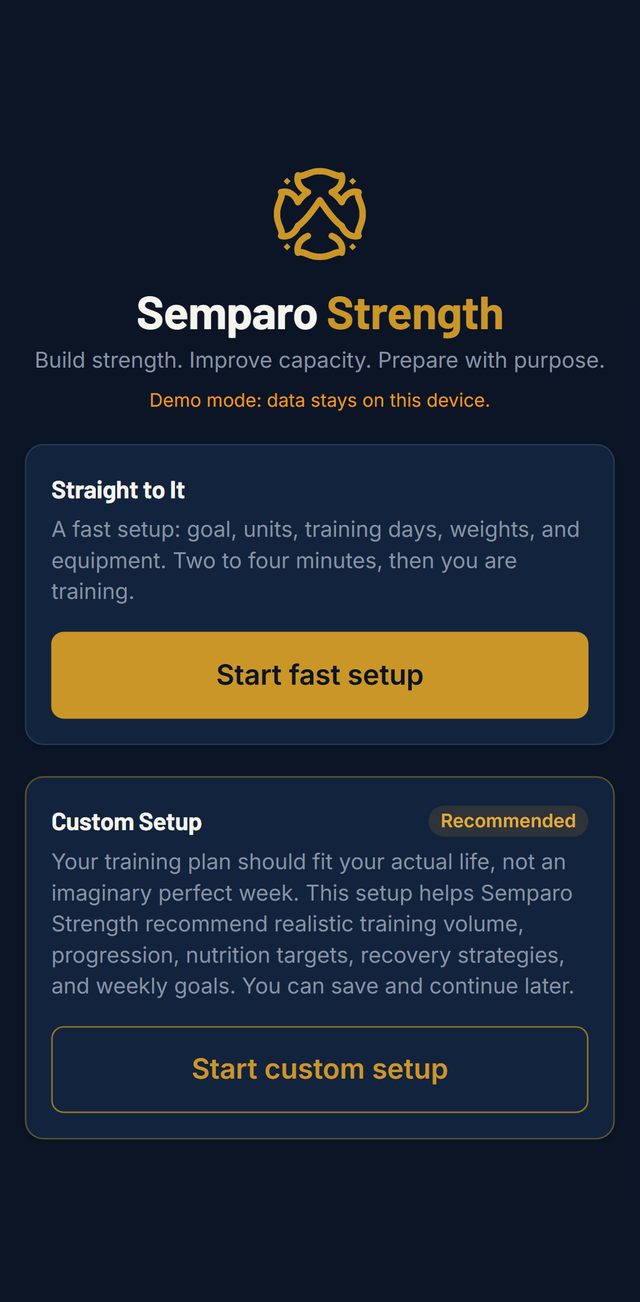
Train and track it in Semparo Strength
Reading the plan is one thing; running it is another. Semparo Strength is our training app, and every fitness program we build lives inside it. The full A/B five-by-five strength program, custom interval and rest timers, and readiness, sleep, and nutrition logging are free for everyone. Every 12-week test program we publish, Fire Test Foundation, Fire Test Foundation + Swim, CPAT, OFAI FPAT, WFX-FIT, University of Alberta Evaluation, York Firefighter Fitness Assessment, Red Deer Polytechnic FPAT, CFFM FPFE, Gledhill Protocol (Halifax), F.A.R.E., and VO2 Max Builder, unlocks with the Fitness unlock or Semparo Pro, with workout-by-workout tracking and the readiness ring. It runs in the browser and installs to a phone home screen in two taps.
Commencez ici
Choisissez votre test physique
Onze programmes : un pour chaque test canadien de pompier portant un nom public, un programme général Foundation quand le vôtre est inconnu, et un VO2 Max Builder axé uniquement sur le conditionnement pour la norme aérobie qui les sous-tend tous.
Connaître le test
Chaque guide de test ci-dessous est gratuit à lire, sans compte : les épreuves, les normes, l'équipement et les conditions de réussite, en plus de l'objectif des 12 semaines. Le programme de force 5x5 dans l'application Semparo Strength est gratuit lui aussi.
Les programmes de 12 semaines
Les onze programmes ci-dessous se débloquent ensemble, le Fire Test Foundation compris : des séances jour par jour à chaque niveau d'équipement, avec des tests de référence toutes les quatre semaines. La section Conditionnement physique coûte 12 $ par mois seule, ou est incluse dans Semparo Pro à 149 $ par année pour toute la plateforme, plus les taxes applicables.
Comparer sur la page des tarifsQuestionnaire d'aptitude
Chaque programme commence par un questionnaire d'aptitude. Ce contenu est éducatif et ne constitue pas une prescription individualisée. Si vous répondez oui à l'une des questions du questionnaire, ou si vous avez des doutes sur votre état de santé, consultez un médecin avant de vous entraîner.
A 12-week base program built from what every Canadian firefighter physical test demands rather than any single one: a big aerobic engine that survives working under 20 to 25 kg of equipment, grip that outlasts the event list, drag and haul strength, striking power, and the ability to repeat near-maximal efforts on short rest. Run it when you do not yet know which test your department will name, when your test is department-specific, or as the block before a test-specific program. That big aerobic engine has a name, VO2 max, and candidates whose department measures it directly can follow this block with the VO2 Max Builder. Complete the PAR-Q+ readiness screen and consult a physician before starting any new exercise program.
A 12-week base program built from what every Canadian firefighter physical test demands rather than any single one: a big aerobic engine that survives working under 20 to 25 kg of equipment, grip that outlasts the event list, drag and haul strength, striking power, and the ability to repeat near-maximal efforts on short rest. Run it when you do not yet know which test your department will name, when your test is department-specific, or as the block before a test-specific program. That big aerobic engine has a name, VO2 max, and candidates whose department measures it directly can follow this block with the VO2 Max Builder. Complete the PAR-Q+ readiness screen and consult a physician before starting any new exercise program. This variant adds one structured pool session each week for departments whose process includes a swim test.
A 12-week periodized program built around the eight CPAT events. Weeks 1 to 4 build an aerobic base, movement patterns, and grip foundation. Weeks 5 to 8 add loaded stair intervals, drag work, and circuit density. Weeks 9 to 11 focus on full circuit simulations, event chaining, and vest acclimation. Week 12 is a taper so you arrive fresh on test day. Every workout offers full gym, minimal equipment, and stairwell-and-vest options. The stair and interval work doubles as VO2 max training; candidates who also face a treadmill or shuttle aerobic standard can pair this with the VO2 Max Builder.
A 12-week periodized program built for the Ontario OFAI pipeline: the Stage Two encapsulated treadmill assessment and the Stage Three FPAT job-related circuit. The plan develops loaded uphill walking capacity, drag and carry strength, grip endurance, and the ability to chain job-simulation events at a steady pace. Complete the PAR-Q+ readiness screen and consult a physician before starting any new exercise program. Its conditioning blocks are VO2 max work by another name, and the VO2 Max Builder extends them for anyone whose department also tests aerobic capacity directly.
A 12-week periodized program built for the national wildland fitness circuit: the pump carries, the kilometre hose-pack carry with its fifty ramp crossings, and the charged hose advance, all inside 14 minutes 30 seconds. The plan develops loaded carrying capacity, ramp and incline power, drag strength, and the metronome pace that gets a crew member through the circuit every single season. Complete the PAR-Q+ readiness screen and consult a physician before starting any new exercise program. The loaded circuit intervals train VO2 max alongside work capacity; the VO2 Max Builder adds a dedicated aerobic block where a department measures that number outright.
A 12-week periodized program for the physical aptitude evaluation run by the Faculty of Kinesiology, Sport, and Recreation at the University of Alberta. It trains the two things the evaluation actually measures: a large aerobic engine that holds up while walking a steep treadmill in full protective equipment, and the strength to produce six near-maximal job efforts on three minutes of rest each. Complete the PAR-Q+ readiness screen and consult a physician before starting any new exercise program. The treadmill portions build the same aerobic capacity a VO2 max assessment measures, and the VO2 Max Builder deepens that side for candidates who need a documented score.
A 12-week program for the York University Firefighter Applicant Fitness Assessment, the two-part evaluation used by departments including Saskatoon, Regina, Mississauga, Richmond BC, and London ON: a maximal treadmill test that measures your VO2 max directly through expired air analysis, then eight job-related performance stations, most of them timed and most performed wearing a 13.5 kg vest with 2.3 kg strapped to each ankle. The treadmill run cannot be pace-managed and the stations reward speed, so this program builds a genuine running engine alongside heavy carries, drags, rope work, and strikes. Complete the PAR-Q+ readiness screen and consult a physician before starting any new exercise program.
A 12-week program for the Firefighter Applicant Physical Aptitude Test run by Red Deer Polytechnic, the evaluation used by Red Deer, Spruce Grove, Lethbridge, and Wood Buffalo (Fort McMurray) emergency services and accepted by Airdrie: a maximal treadmill ramp test with a published pass line of 12 minutes 30 seconds, then six job stations performed in a 45-pound weighted vest on exactly 90 seconds of rest each. The ramp table is public, so this program trains it precisely: real running on rising grades, plus carries, rope pulls, strikes, drags, and ladder work at the test's own loads and time limits. Complete the PAR-Q+ readiness screen and consult a physician before starting any new exercise program. The shuttle preparation is VO2 max training under a different clock; candidates chasing a numeric aerobic score can add the VO2 Max Builder.
A 12-week program for the Canadian Forces Fire Marshal's Firefighter Pre-Entry Fitness Evaluation, the test behind Canadian Forces firefighter hiring and, through the University of Manitoba, the Winnipeg Fire Paramedic Service's one-attempt fitness gate, Brandon's accepted certificate, and a test St. John's accepts with a documented VO2 max. Everything happens in roughly 22 kg of full firefighting ensemble: a treadmill walk whose pass line is 13 minutes including 8 minutes at 3.5 mph on a 10 percent grade, then six job stations with published time standards on 3-minute rests. The engine here is loaded walking, not running, and this program builds it from week one, alongside the carries, holds, pulls, strikes, drags, and ladder cadence the stations measure. Complete the PAR-Q+ readiness screen and consult a physician before starting any new exercise program.
A 12-week program for the Gledhill Fitness Protocol as Halifax Regional Fire and Emergency runs it: the Leger 20-metre shuttle run first, where career candidates must reach a VO2 max of 42.5 mL/kg/min to stay in the competition, then eight job-related stations, most timed and most performed in a 14.5 kg vest with 1.8 kg strapped to each ankle. The shuttle run is a field test that punishes poor pacing and sloppy turns as much as a small engine, so this program trains all three, alongside the carries, hoists, drags, and strikes the stations measure at Halifax's own loads. Complete the PAR-Q+ readiness screen and consult a physician before starting any new exercise program.
A 12-week, three-day-a-week program for the Functional Abilities Recruitment Evaluation, the Lifemark-run test required for Alberta Health Services paramedic and EMR hiring province-wide and for Lethbridge's paramedic-first fire recruitment. The test is a functional screen (a crate lift and front carry progressed to 48 kg, dual 9 kg side carries, and a 2-minute kneeling position tolerance) plus a partnered 15-minute circuit built around a 95.5 kg stretcher, spine board, and stair chair, with 2 minutes of unbroken CPR in the middle. Most active candidates find the F.A.R.E. manageable, and this program is honest about that: it exists so a 150-dollar test with a six-month certificate gets passed cleanly on the first booking, with nothing on the day unfamiliar, including the resting heart rate and blood pressure screen that can end the appointment before it starts. Complete the PAR-Q+ readiness screen and consult a physician before starting any new exercise program. Its conditioning develops the aerobic engine a VO2 max test measures; the VO2 Max Builder is the standalone version for departments that assess that capacity directly.
A purely conditioning 12-week program for the aerobic standard behind Canadian fire service testing. Built around the WFI sub-maximal treadmill evaluation used by Wellness-Fitness Initiative departments and the 42.5 mL/kg/min benchmark that recurs across occupational standards, trained with margin because the estimating equations are wide. Heart-rate paced throughout: the test itself ends at 85% of age-predicted max, so threshold discipline is test preparation. No strength work; pair it with your test-specific program's strength days or your own lifting.
Pourquoi s’entraîner tôt
Un test physique est un problème de calendrier, pas seulement de forme physique
Les candidats s’entraînent pour les épreuves et oublient le calendrier. Les épreuves sont la partie facile à planifier. Ce qui coûte vraiment une année aux gens, c’est d’arriver à un affichage de poste sans réussite encore valide, et presque toutes les contraintes ci-dessous sont déjà inscrites dans les guides par ville de ce site. Les règles de reprise sont fixées par chaque administrateur, alors confirmez les vôtres avant de réserver une date.
Votre résultat expire selon son propre calendrier
Une réussite est couramment valide pendant environ un an, mais cette fenêtre est fixée par l’administrateur et par le service qui embauche, pas par le test lui-même. Les services albertains qui acceptent l’évaluation de l’University of Alberta, le FPAT du Red Deer Polytechnic ou le CPAT indiquent 12 mois. Victoria et Esquimalt exigent une réussite datée de moins d’un an avant la date de l’affichage. Des services peuvent exiger une fenêtre plus courte, et le font, alors lisez l’affichage plutôt que de présumer un an.
Les affichages ouvrent selon le leur
Toronto affiche à peu près une fois par année. Kelowna recrute tous les deux ou trois ans pour constituer une liste d’admissibilité. Certains services n’acceptent les candidatures que pendant un seul mois de l’année. Le dossier d’un service indique clairement qu’il n’y a aucune liste d’attente entre les concours et que les candidats non retenus doivent postuler de nouveau aux affichages à venir. Votre certificat et leur fenêtre doivent se chevaucher, et vous n’en contrôlez qu’un seul des deux.
Un échec peut mettre fin au concours, pas seulement à la journée
Calgary place le test physique à la septième étape de son processus et indique que le fait de ne pas le réussir entraîne le retrait du processus de candidature. La reprise elle-même est souvent rapide : l’OFAI de l’Ontario permet une reprise 15 jours après un premier échec, et un administrateur du CPAT en Ontario permet une deuxième tentative le jour même, moyennant des frais réduits. Mais une reprise rapide ne vous remet pas dans un concours dont vous avez déjà été retiré.
Chaque tentative est à vos frais
Les frais canadiens publiés vont d’environ 200 $ au Calgary Fire Department à 350 $ à Abbotsford Fire Rescue et 399 $ pour l’évaluation de l’University of Alberta, aux frais du candidat, par séance. Une deuxième tentative coûte de nouveau ce montant, en plus de ce que le calendrier vous coûte.
Ce que cela signifie pour le moment de commencer
Personne ne peut vous promettre une réussite, et ce site ne le fera jamais. Ce qu’un programme de douze semaines vous procure, c’est de la marge : vous arrivez au test déjà capable de faire le travail, avec un test de référence aux semaines quatre et huit qui vous dit honnêtement si vous êtes sur la bonne voie pendant qu’il reste du temps pour corriger le tir. L’apprendre le jour du test coûte bien plus qu’un mauvais après-midi. C’est une autre séance à payer, et l’attente d’une fenêtre qui peut être à un an ou trois de là, passée dans l’emploi que vous essayez de quitter.
Semparo Pro coûte 149 $ par année et couvre chaque étape du cycle d'embauche, soit à peu près ce que coûte à elle seule une reprise de l'évaluation physique. La section Conditionnement physique seule coûte 12 $ par mois. Les deux comprennent les quatre programmes de 12 semaines et l'application Strength qui les fait fonctionner, sans frais par tentative. Les prix sont en dollars canadiens et excluent les taxes ; les taxes applicables sont ajoutées au paiement.
Associez le programme à l'affichage de poste
Qui utilise quel test
Chaque test canadien de pompier portant un nom public a un programme ici, et voici les principaux services de sécurité incendie que nos guides vérifiés associent à chacun. Ce qu'aucune plateforme ne peut lister, c'est environ un service sur cinq qui mène sa propre évaluation, en plus des nombreux qui n'en publient aucune : pour ceux-là, l'affichage de poste est la seule source, et le Fire Test Foundation est la préparation. Les services changent de test d'une embauche à l'autre, alors l'affichage auquel vous postulez fait toujours foi.
- CPAT
Calgary, Ottawa, Hamilton, Windsor, Burlington, Moncton, Abbotsford, Prince George et Nanaimo, et accepté par Airdrie et St. John's.
- OFAI FPAT
Toronto, Brampton, Waterloo, Oakville, Oshawa et Toronto Pearson (GTAA), London acceptant les résultats de l'OFAI comme solution de rechange.
- WFX-FIT
Les agences provinciales et territoriales de lutte contre les feux de végétation qui embauchent des équipes saisonnières et des équipes d'unité selon la norme d'échange du CIFFC.
- Évaluation de l'Université de l'Alberta
Edmonton, St. Albert, Medicine Hat, Strathcona County, Spruce Grove et Fort McMurray (Wood Buffalo). Red Deer l'offre comme choix de site, Airdrie l'accepte, et cinq services du Grand Victoria et de la North Shore, en Colombie-Britannique, acceptent les tests de l'Université de Victoria ou de l'Université de l'Alberta.
- Évaluation York
Saskatoon, Regina, Mississauga, London et Richmond en Colombie-Britannique, et accepté par St. John's.
- FPAT du Red Deer Polytechnic
Red Deer, Spruce Grove, Lethbridge et Wood Buffalo (Fort McMurray) selon la liste de RDP, et accepté par Airdrie.
- FPFE des Forces canadiennes
Winnipeg (un essai par concours), les services d'incendie des Forces armées canadiennes et du MDN, et les Laboratoires Nucléaires Canadiens, Brandon et St. John's acceptant les attestations en cours de validité.
- Protocole Gledhill
Halifax Regional Fire and Emergency, pompiers permanents et pompiers volontaires.
- F.A.R.E.
L'embauche de paramédics et d'intervenants médicaux d'urgence (EMR) par Alberta Health Services partout dans la province, et le recrutement de pompiers axé sur les paramédics à Lethbridge.
- Fire Test Foundation
Le bon point de départ quand votre service mène sa propre évaluation, comme le font Montréal, Québec, Surrey, Burnaby et une trentaine d'autres à notre dossier, ou n'a jamais publié quel test il utilise.
Préparation à la nage
Le test de natation, en partant de la partie profonde
Plusieurs services canadiens incluent une épreuve de natation et de surplace, et c'est celle qu'un candidat en réorientation de carrière risque le plus d'échouer par surprise. Vous n'avez pas besoin d'être rapide. Vous devez rester calme, flotter quand vous fatiguez et franchir la distance sans arrêter. Voici la progression honnête du débutant jusqu'à la préparation au test.
Water is the one event where being unprepared is dangerous, not just disqualifying. Train in a lifeguarded pool, never alone, and if you are a beginner, start with a certified swim instructor: a few private adult lessons are the fastest and safest way through the first two phases below. This is a preparation guide, not a substitute for swim instruction.
Ce que le test de natation comprend habituellement
- Tread water for a set time, often one to two minutes, sometimes with your hands out of the water, without touching the wall or the bottom.
- Swim a continuous distance without stopping or standing, commonly one to four pool lengths (roughly 25 to 100 metres), usually any stroke you like.
- In some departments, retrieve an object from the deep end, and a few run the swim in a t-shirt and shorts rather than swimwear.
- It may come after other physical events, so you will not be fresh. Only some departments include a swim or tread component, and where they do the exact standard is always in that department's own posting.
Water comfort and breath control
Be calm and in control with your face under and your feet off the bottom. This phase is for anyone uneasy in deep water; skip it only if you already are not.
Exercices
- Bobbing: submerge, exhale slowly through the nose, stand back up, repeat until it feels boring
- Open your eyes underwater (goggles are fine) and blow a slow, steady stream of bubbles
- Wall holds: grip the gutter in chest-deep water and let your legs float up behind you
- Push-and-glide off the wall in a streamline, face down, then stand up under control
Prêt à passer à l'étape suivante
You can submerge fully, exhale slowly, and recover to standing with no rush of panic, and hold a face-down glide for a few seconds.
Floating and rhythmic breathing
Float on your front and back and breathe in a rhythm. Floating is what keeps you safe if you tire, so it comes before stroke.
Exercices
- Back float: relax, ears in the water, hips up, for as long as you stay loose
- Front float or starfish, then roll from front to back and back again
- Flutter kick one width with a kickboard, breathing to the side without lifting the head
- Streamline glide with a kick off the wall, adding a couple of metres each session
Prêt à passer à l'étape suivante
You can back-float relaxed for 30 seconds and kick one pool width with a board while breathing to the side.
Freestyle you can repeat
Swim continuous front crawl with a breathing pattern you can hold. Efficient and unhurried beats fast and gassed.
Exercices
- Catch-up drill: one arm waits at full extension until the other hand meets it
- Six-kick switch: six kicks on your side, then one stroke to roll to the other side
- Breathe every third stroke to keep both sides even
- Single-arm freestyle with the other arm at your side, then string the strokes together
Prêt à passer à l'étape suivante
You can swim 25 metres of freestyle without stopping, breathing in a steady rhythm and finishing calm.
Treading water and distance
Stay up without swimming, and swim past the test distance so the real thing feels short.
Exercices
- Eggbeater or scissor kick to tread water; build from 30 seconds toward two minutes
- Tread with your hands out of the water in short bursts, since some tests require it
- Sculling: small figure-eight hand sweeps that hold you in place
- Build continuous swimming to 100 to 200 metres, then add short interval sets to raise your pace
Prêt à passer à l'étape suivante
You can tread water for two minutes, some of it with hands up, and swim 100 metres without stopping.
Rehearse the real test
Turn swimming into a pass. Simulate your department's exact standard until it is routine.
Exercices
- Swim your department's published distance without stopping, then tread for its required time, back to back
- If the posting says clothed, rehearse in a t-shirt and shorts: wet cotton changes everything
- Practice an object retrieval from the deep end if your test includes one
- Do the swim after a few minutes of hard land exercise, so you rehearse it tired, the way test day runs it
Prêt à passer à l'étape suivante
You can complete your department's swim standard with margin to spare, breathing under control from start to finish.
Apprenez à nager avec un instructeur certifié avant de vous exercer seul, et entraînez-vous toujours dans une piscine surveillée par un sauveteur. Ces conseils sont éducatifs et ne constituent ni une prescription individualisée ni un substitut à des cours de natation.
École des recrues
Prêt pour l'école des recrues, pas seulement pour le test
Réussir le CPAT ou le FPAT vous ouvre la porte. L'école des recrues est une tout autre affaire : des semaines de manœuvres avec environ 60 lb d'équipement, des gants et un casque, où la mobilité et l'endurance dans des positions inconfortables déterminent qui s'en sort. Voici les tâches que les écoles canadiennes évaluent, les capacités que chacune exige, et un autotest pour chacune : si l'autotest est difficile, c'est là votre priorité d'entraînement.
Les habitudes avant l'équipement
Entraînez-vous comme si l'habit était sur vous
- Train in a weighted vest and thick work gloves, including for ordinary chores: gear adds roughly 60 lbs, and grip, core, and back endurance in gloves is a different sport than a bare-handed gym session.
- No vest? Wear two loaded backpacks, one on the chest and one on the back, cinched tight.
- Build heat tolerance deliberately: 20 to 30 minutes of work in sweats in a warm space, while learning your own hydration and recovery needs. Academies do not pause for weather.
- Train your cardio regularly, and practice controlling your breathing under load: air management starts long before your first SCBA.
- Bias your strength work toward single-arm, single-leg, and uneven loads: nothing on a fireground is balanced.
- Prioritize trunk and low-back endurance in every position you will actually work in: standing, kneeling, lunging, lying, and crawling.
La capacité que l'habit met à l'épreuve en premier
Une mobilité qui résiste à l'habit de combat
La mobilité des hanches, de l'aine et des épaules porte chaque manœuvre de recherche, de sauvetage et de boyau, et l'habit rend tout cela plus difficile. Intégrez ces exercices à votre routine générale :
Cossack squats
Wide stance, shift over one heel into a deep side squat, other leg straight. Opens hips and groin for low work in gear. 2 sets of 6 per side.
Duck walks
Walk forward in a full-depth squat, chest up. Builds hip and ankle range you can actually use at the bottom. 2 rounds of 10 steps.
Quadruped kick-throughs
From all fours, lift a hand, rotate, and kick the opposite leg through. Hips and upper back for crawling and turning in tight spaces. 2 sets of 5 per side.
Shin box switch with hip lift
Seated with both knees at 90 degrees, switch sides, then drive the hips up. Controlled internal and external hip rotation. 2 sets of 5 switches.
Shoulder dowel pullovers
Hold a dowel wide, take it overhead and behind with straight arms as far as comfortable. Restores the overhead range ladder and tool work demands. 2 sets of 10.
T-spine rotations on the wall
Half-kneeling beside a wall, rotate the chest open and follow the hand with your eyes. Upper-back rotation that packs and gear steal. 2 sets of 6 per side.
Scapular pull-ups
Dead hang, lift and lower the body a few inches without bending the elbows. Teaches the shoulder blades to move under load. 2 sets of 6.
Prone snow angels
Face down, sweep straight arms from hips to overhead without touching the floor. Endurance for the small stabilizers behind the shoulders. 2 sets of 8 slow reps.
Child's pose with shoulder flexion
Sit back on the heels, arms long on the floor, breathe into the upper back. A reset for lats and shoulders after loaded work. 3 slow breaths, 2 rounds.
Windmills
Light kettlebell locked overhead, hinge and rotate to touch the floor with the free hand. Shoulder stability and hip mobility in one move. 2 sets of 5 per side, light.
Turkish get-ups
Floor to standing and back down with a weight locked out overhead, slowly. Every position a fireground demands in one rep. 2 sets of 2 per side, light and unhurried.
Ce que l'école des recrues évalue vraiment
Les tâches de l'école des recrues, une par une
Travail à l'échelle, hissage d'outils, recherche, traînées de sauvetage, entrée forcée et le reste : chaque tâche ci-dessous nomme les capacités qu'elle exige, propose un autotest et énumère les exercices qui la développent.
Ladder work
Upper body strengthLower body strengthCore and trunk enduranceGrip strengthLift, carry, raise, and extend ground ladders in the 24 to 28 foot range, weighing roughly 72 to 89 lbs, then return them under control. Shorter candidates lean on lower-body power where taller candidates can leverage the upper body: know which one you are and train it.
Testez-vous
Landmine deadlift to rotational press: start at a 10 to 25 lb plate on the bar for 3 to 5 reps per side, and build toward a single clean rep per side at 35 to 45 lbs. It mirrors levering a ladder's weight overhead with the whole body.
Développez-la avec (touchez pour les séries, les charges et le repos)
Barbell clean and press, or dumbbell shoulder press
Charge
A weight you could press 8 times with clean form
Séries et répétitions
4 sets of 5
Repos
2 minutes between sets
Fréquence
Twice a week
Learn the barbell clean from a coach before loading it.
Racked and overhead single-arm carries
Charge
25 to 50 lb kettlebell or dumbbell
Séries et répétitions
3 rounds of 20 to 30 m per arm, in each position
Repos
60 to 90 seconds between rounds
Fréquence
Twice a week
Landmine lunge and press
Charge
10 to 25 lb plate on the bar
Séries et répétitions
3 sets of 6 per side
Repos
90 seconds between sets
Fréquence
Once or twice a week
Straight-arm cable pulldown with a long attachment
Charge
A weight you could pull 15 times, kept strict
Séries et répétitions
3 sets of 10 to 12
Repos
60 to 90 seconds between sets
Fréquence
Twice a week
Farmer's and suitcase carries with gloves on
Charge
Heavy enough that 40 m is work, posture never breaks
Séries et répétitions
4 rounds of 20 to 40 m
Repos
90 seconds between rounds
Fréquence
Two or three times a week
Heavy sandbag carry on one shoulder, if you have one
Charge
60 to 100 lb bag
Séries et répétitions
3 rounds of 20 m per shoulder
Repos
90 seconds between rounds
Fréquence
Once a week
Tool hoist
Grip strengthUpper body strength and enduranceCore and trunk enduranceHaul a roughly 45 lb hose coil up two to four storeys on a rope, hand over hand with thumbs up, lift it over the railing, then lower it back to the ground without letting the rope slide. Efficient hoisting is a whole-body pull, not an arm exercise.
Testez-vous
Alternating upright rows with a 50 lb dumbbell or kettlebell in each hand: 30 seconds on, 5 seconds rest, 30 seconds on. If your grip quits before your shoulders, you have your answer.
Développez-la avec (touchez pour les séries, les charges et le repos)
Single-arm cable upright row
Charge
A weight you could row 15 times
Séries et répétitions
3 sets of 10 to 12 per side
Repos
60 to 90 seconds between sets
Fréquence
Twice a week
Rope pulls on a sled or plate, with a hose or battle rope
Charge
45 to 90 lb on the sled or plate
Séries et répétitions
4 pulls of 15 to 20 m, hand over hand
Repos
90 seconds between pulls
Fréquence
Once or twice a week
Thumbs up on the rope, the same grip the evolution demands.
Farmer's carries with gloves
Charge
The heaviest pair you can hold for 40 m
Séries et répétitions
4 rounds of 40 m
Repos
90 seconds between rounds
Fréquence
Two or three times a week
Prone incline alternating dumbbell rows
Charge
A pair you could row 12 times together
Séries et répétitions
3 sets of 10 per side
Repos
90 seconds between sets
Fréquence
Twice a week
Single-arm cable pull with rotation
Charge
Moderate, kept smooth and controlled
Séries et répétitions
3 sets of 8 to 10 per side
Repos
60 to 90 seconds between sets
Fréquence
Twice a week
Search
Heat toleranceCardiovascular enduranceMetabolic conditioningShoulder and hip mobilityUpper body, lower body, and trunk enduranceSweep a low-visibility area on knees and belly for up to 25 minutes: lunging slides, floor sweeps with full shoulder range, push-ups back to kneeling, lateral movement, repeat. It is cardio in disguise, and the heat load is real.
Testez-vous
A vest-and-gloves circuit, five rounds: 20 alternating step-ups to knee height, bear crawl 10 steps forward, 10 low-impact burpees, bear crawl 10 steps back. Pace it, breathe, hold form. A falling round time across sessions means it is working.
Développez-la avec (touchez pour les séries, les charges et le repos)
Low-impact burpees in a weight vest
Charge
Bodyweight plus vest
Séries et répétitions
5 rounds of 10, inside a circuit
Repos
60 seconds between rounds
Fréquence
Twice a week
Front-racked weighted lunges
Charge
Two 25 to 35 lb kettlebells at the chest
Séries et répétitions
3 sets of 8 per leg
Repos
90 seconds between sets
Fréquence
Twice a week
Bear crawl kettlebell pull-throughs, forward and lateral
Charge
25 to 50 lb kettlebell
Séries et répétitions
4 crawls of 10 m, dragging the bell through
Repos
60 seconds between crawls
Fréquence
Twice a week
Push-ups in a weight vest
Charge
Bodyweight plus vest
Séries et répétitions
4 sets of 8 to 15, stopping 3 shy of failure
Repos
60 to 90 seconds between sets
Fréquence
Two or three times a week
Plank rotations in a weight vest
Charge
Bodyweight plus vest
Séries et répétitions
3 holds of 30 to 45 seconds with slow rotations
Repos
60 seconds between holds
Fréquence
Two or three times a week
Rescue drags and lifts
Grip strengthUpper and lower body strength and enduranceCore enduranceMetabolic conditioningHip mobilityMove a rescue dummy of roughly 160 lbs, and sometimes a classmate or instructor, using kneeling drags, reverse drags with an elbow lock, and foot-hold drags, over distances that change with the scenario. Technique is taught at the academy; the strength to express it is yours to build now.
Testez-vous
Low sled drags with handles, elbows bent, in a vest and gloves, loaded to about 160 lbs total: 45 seconds on, 30 seconds rest, five rounds.
Développez-la avec (touchez pour les séries, les charges et le repos)
Sled pulls: forward, backward, and lateral
Charge
Start near 90 lb total and build toward 160 lb and past it
Séries et répétitions
5 pulls of 20 m, rotating the three directions
Repos
60 to 90 seconds between pulls
Fréquence
Twice a week
No sled? A tarp or old tire loaded with plates on grass does the job.
Quadruped kettlebell pull-throughs
Charge
35 to 50 lb kettlebell
Séries et répétitions
4 crawls of 10 m
Repos
60 seconds between crawls
Fréquence
Twice a week
Kneeling slides with a heavy medicine ball
Charge
20 to 30 lb ball
Séries et répétitions
3 trips of 10 m, kneeling, ball dragged along
Repos
60 to 90 seconds between trips
Fréquence
Once or twice a week
Front-racked kettlebell or Zercher squats
Charge
A weight you could squat 8 times
Séries et répétitions
4 sets of 6
Repos
2 minutes between sets
Fréquence
Twice a week
Deadlifts
Charge
A weight you could pull for 8 clean reps
Séries et répétitions
4 sets of 5
Repos
2 to 3 minutes between sets
Fréquence
Twice a week
Never to failure: the drag rewards repeatable strength, not one grinding max.
Hose work
Upper body strength and enduranceGrip strengthCore enduranceMetabolic conditioningKneeling mobilityAdvance a charged line from standing and from a half-kneel: hose pinned at the hip, driving with the legs, hips leading, body square, head up. The kneeling advance is a lunge pattern under constant resistance.
Testez-vous
Forward sled pull gripped at the hips, in a vest and gloves, at least a 45 lb plate on the sled, at a brisk walk: 30 seconds on, 30 seconds rest, five rounds.
Développez-la avec (touchez pour les séries, les charges et le repos)
Sled pushes and forward sled pulls
Charge
90 to 135 lb total
Séries et répétitions
6 efforts of 15 to 20 m
Repos
60 to 90 seconds between efforts
Fréquence
Twice a week
Walking kettlebell lunges in a vest
Charge
Two 25 to 35 lb kettlebells
Séries et répétitions
3 sets of 10 steps per leg
Repos
90 seconds between sets
Fréquence
Twice a week
Partner-resisted walking lunges
Charge
A partner or heavy band resisting from behind
Séries et répétitions
3 trips of 10 m
Repos
90 seconds between trips
Fréquence
Once a week
Racked kettlebell lateral lunges
Charge
25 to 35 lb kettlebell at the chest
Séries et répétitions
3 sets of 6 per side
Repos
90 seconds between sets
Fréquence
Twice a week
Split-stance Pallof presses
Charge
A band or cable you can hold steady for every rep
Séries et répétitions
3 sets of 10 per side
Repos
60 seconds between sets
Fréquence
Two or three times a week
Chaque nom d'exercice ci-dessus fait partie du vocabulaire courant du gym : cherchez-en un pour trouver une démonstration vidéo, et apprenez toujours les mouvements qui ne vous sont pas familiers avec un entraîneur certifié avant de les charger. Ces conseils sont éducatifs et ne constituent pas une prescription individualisée.