Physical test training
Train for the test you are actually booked into.
Companion training app
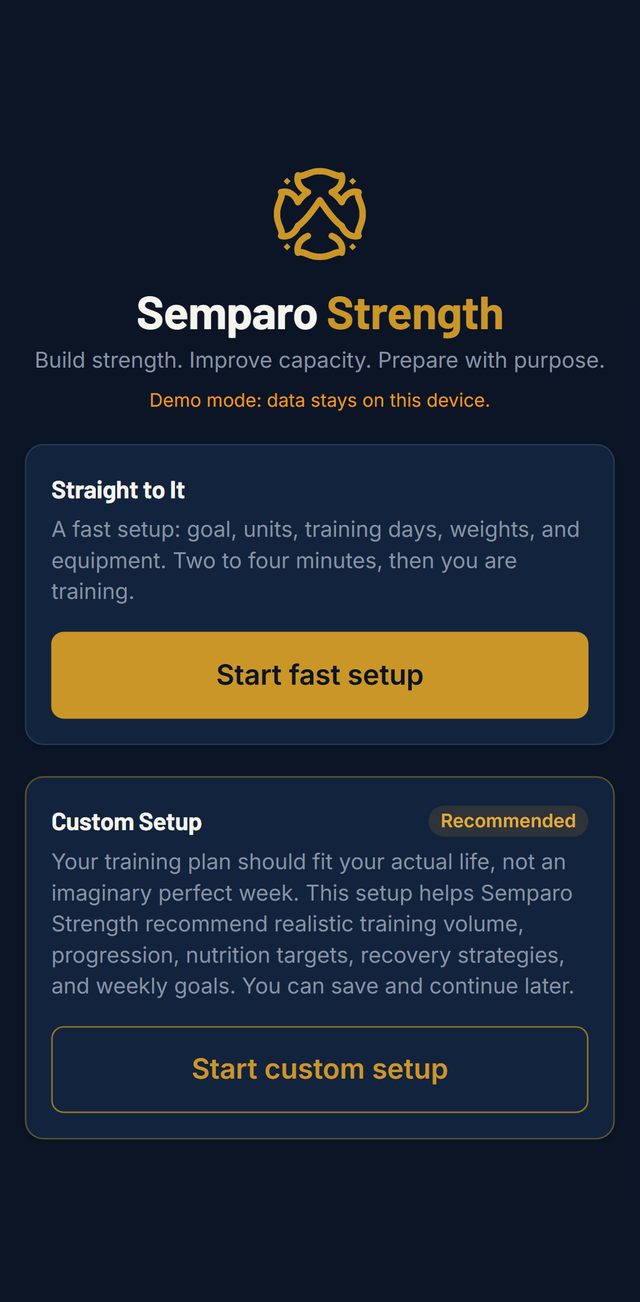
Train and track it in Semparo Strength
Reading the plan is one thing; running it is another. Semparo Strength is our training app, and every fitness program we build lives inside it. The full A/B five-by-five strength program, custom interval and rest timers, and readiness, sleep, and nutrition logging are free for everyone. Every 12-week test program we publish, Fire Test Foundation, Fire Test Foundation + Swim, CPAT, OFAI FPAT, WFX-FIT, University of Alberta Evaluation, York Firefighter Fitness Assessment, Red Deer Polytechnic FPAT, CFFM FPFE, Gledhill Protocol (Halifax), F.A.R.E., and VO2 Max Builder, unlocks with the Fitness unlock or Semparo Pro, with workout-by-workout tracking and the readiness ring. It runs in the browser and installs to a phone home screen in two taps.
Start here
Choose your physical test
Eleven programs: one for every Canadian fire test with a public name, a general Foundation program when yours is unknown, and a conditioning-only VO2 Max Builder for the aerobic standard behind them all.
Know the test
Every test guide below is free to read, no account: the events, the standards, the equipment, and the pass conditions, plus the focus of all 12 weeks. The 5x5 strength program in the Semparo Strength app is free too.
The 12-week programs
All eleven programs below unlock together, the Fire Test Foundation included: day-by-day sessions at every equipment tier, with benchmarks every four weeks. The Fitness section is $12 a month on its own, or included in Semparo Pro at $149 a year for the whole platform, plus applicable taxes.
Compare on the pricing pageReadiness screening
Every program starts with a readiness screen. This content is educational, not an individualized prescription. If you answer yes to any screening question, or you are unsure about your health status, consult a physician before training.
A 12-week base program built from what every Canadian firefighter physical test demands rather than any single one: a big aerobic engine that survives working under 20 to 25 kg of equipment, grip that outlasts the event list, drag and haul strength, striking power, and the ability to repeat near-maximal efforts on short rest. Run it when you do not yet know which test your department will name, when your test is department-specific, or as the block before a test-specific program. That big aerobic engine has a name, VO2 max, and candidates whose department measures it directly can follow this block with the VO2 Max Builder. Complete the PAR-Q+ readiness screen and consult a physician before starting any new exercise program.
A 12-week base program built from what every Canadian firefighter physical test demands rather than any single one: a big aerobic engine that survives working under 20 to 25 kg of equipment, grip that outlasts the event list, drag and haul strength, striking power, and the ability to repeat near-maximal efforts on short rest. Run it when you do not yet know which test your department will name, when your test is department-specific, or as the block before a test-specific program. That big aerobic engine has a name, VO2 max, and candidates whose department measures it directly can follow this block with the VO2 Max Builder. Complete the PAR-Q+ readiness screen and consult a physician before starting any new exercise program. This variant adds one structured pool session each week for departments whose process includes a swim test.
A 12-week periodized program built around the eight CPAT events. Weeks 1 to 4 build an aerobic base, movement patterns, and grip foundation. Weeks 5 to 8 add loaded stair intervals, drag work, and circuit density. Weeks 9 to 11 focus on full circuit simulations, event chaining, and vest acclimation. Week 12 is a taper so you arrive fresh on test day. Every workout offers full gym, minimal equipment, and stairwell-and-vest options. The stair and interval work doubles as VO2 max training; candidates who also face a treadmill or shuttle aerobic standard can pair this with the VO2 Max Builder.
A 12-week periodized program built for the Ontario OFAI pipeline: the Stage Two encapsulated treadmill assessment and the Stage Three FPAT job-related circuit. The plan develops loaded uphill walking capacity, drag and carry strength, grip endurance, and the ability to chain job-simulation events at a steady pace. Complete the PAR-Q+ readiness screen and consult a physician before starting any new exercise program. Its conditioning blocks are VO2 max work by another name, and the VO2 Max Builder extends them for anyone whose department also tests aerobic capacity directly.
A 12-week periodized program built for the national wildland fitness circuit: the pump carries, the kilometre hose-pack carry with its fifty ramp crossings, and the charged hose advance, all inside 14 minutes 30 seconds. The plan develops loaded carrying capacity, ramp and incline power, drag strength, and the metronome pace that gets a crew member through the circuit every single season. Complete the PAR-Q+ readiness screen and consult a physician before starting any new exercise program. The loaded circuit intervals train VO2 max alongside work capacity; the VO2 Max Builder adds a dedicated aerobic block where a department measures that number outright.
A 12-week periodized program for the physical aptitude evaluation run by the Faculty of Kinesiology, Sport, and Recreation at the University of Alberta. It trains the two things the evaluation actually measures: a large aerobic engine that holds up while walking a steep treadmill in full protective equipment, and the strength to produce six near-maximal job efforts on three minutes of rest each. Complete the PAR-Q+ readiness screen and consult a physician before starting any new exercise program. The treadmill portions build the same aerobic capacity a VO2 max assessment measures, and the VO2 Max Builder deepens that side for candidates who need a documented score.
A 12-week program for the York University Firefighter Applicant Fitness Assessment, the two-part evaluation used by departments including Saskatoon, Regina, Mississauga, Richmond BC, and London ON: a maximal treadmill test that measures your VO2 max directly through expired air analysis, then eight job-related performance stations, most of them timed and most performed wearing a 13.5 kg vest with 2.3 kg strapped to each ankle. The treadmill run cannot be pace-managed and the stations reward speed, so this program builds a genuine running engine alongside heavy carries, drags, rope work, and strikes. Complete the PAR-Q+ readiness screen and consult a physician before starting any new exercise program.
A 12-week program for the Firefighter Applicant Physical Aptitude Test run by Red Deer Polytechnic, the evaluation used by Red Deer, Spruce Grove, Lethbridge, and Wood Buffalo (Fort McMurray) emergency services and accepted by Airdrie: a maximal treadmill ramp test with a published pass line of 12 minutes 30 seconds, then six job stations performed in a 45-pound weighted vest on exactly 90 seconds of rest each. The ramp table is public, so this program trains it precisely: real running on rising grades, plus carries, rope pulls, strikes, drags, and ladder work at the test's own loads and time limits. Complete the PAR-Q+ readiness screen and consult a physician before starting any new exercise program. The shuttle preparation is VO2 max training under a different clock; candidates chasing a numeric aerobic score can add the VO2 Max Builder.
A 12-week program for the Canadian Forces Fire Marshal's Firefighter Pre-Entry Fitness Evaluation, the test behind Canadian Forces firefighter hiring and, through the University of Manitoba, the Winnipeg Fire Paramedic Service's one-attempt fitness gate, Brandon's accepted certificate, and a test St. John's accepts with a documented VO2 max. Everything happens in roughly 22 kg of full firefighting ensemble: a treadmill walk whose pass line is 13 minutes including 8 minutes at 3.5 mph on a 10 percent grade, then six job stations with published time standards on 3-minute rests. The engine here is loaded walking, not running, and this program builds it from week one, alongside the carries, holds, pulls, strikes, drags, and ladder cadence the stations measure. Complete the PAR-Q+ readiness screen and consult a physician before starting any new exercise program.
A 12-week program for the Gledhill Fitness Protocol as Halifax Regional Fire and Emergency runs it: the Leger 20-metre shuttle run first, where career candidates must reach a VO2 max of 42.5 mL/kg/min to stay in the competition, then eight job-related stations, most timed and most performed in a 14.5 kg vest with 1.8 kg strapped to each ankle. The shuttle run is a field test that punishes poor pacing and sloppy turns as much as a small engine, so this program trains all three, alongside the carries, hoists, drags, and strikes the stations measure at Halifax's own loads. Complete the PAR-Q+ readiness screen and consult a physician before starting any new exercise program.
A 12-week, three-day-a-week program for the Functional Abilities Recruitment Evaluation, the Lifemark-run test required for Alberta Health Services paramedic and EMR hiring province-wide and for Lethbridge's paramedic-first fire recruitment. The test is a functional screen (a crate lift and front carry progressed to 48 kg, dual 9 kg side carries, and a 2-minute kneeling position tolerance) plus a partnered 15-minute circuit built around a 95.5 kg stretcher, spine board, and stair chair, with 2 minutes of unbroken CPR in the middle. Most active candidates find the F.A.R.E. manageable, and this program is honest about that: it exists so a 150-dollar test with a six-month certificate gets passed cleanly on the first booking, with nothing on the day unfamiliar, including the resting heart rate and blood pressure screen that can end the appointment before it starts. Complete the PAR-Q+ readiness screen and consult a physician before starting any new exercise program. Its conditioning develops the aerobic engine a VO2 max test measures; the VO2 Max Builder is the standalone version for departments that assess that capacity directly.
A purely conditioning 12-week program for the aerobic standard behind Canadian fire service testing. Built around the WFI sub-maximal treadmill evaluation used by Wellness-Fitness Initiative departments and the 42.5 mL/kg/min benchmark that recurs across occupational standards, trained with margin because the estimating equations are wide. Heart-rate paced throughout: the test itself ends at 85% of age-predicted max, so threshold discipline is test preparation. No strength work; pair it with your test-specific program's strength days or your own lifting.
Why train early
A physical test is a timing problem, not just a fitness one
Candidates train for the events and forget the calendar. The events are the easy part to plan for. What actually costs people a year is arriving at a posting without a current pass, and almost every constraint below is already written into the city guides on this site. Retest rules are set by each administrator, so confirm yours before you book a date.
Your result expires on its own clock
A pass is commonly good for about a year, but that window is set by the administrator and the hiring department, not by the test itself. Alberta services accepting the University of Alberta evaluation, Red Deer Polytechnic FPAT, or CPAT list 12 months. Victoria and Esquimalt want a pass dated within one year of the posting date. Departments can and do ask for a shorter one, so read the posting rather than assuming a year.
Postings open on theirs
Toronto posts roughly annually. Kelowna recruits every two to three years to an eligibility list. Some services take applications inside a single month of the year. One department's record states plainly that there is no waiting list between competitions and unsuccessful candidates must reapply to future postings. Your certificate and their window have to overlap, and you only control one of the two.
Failing can end that competition, not just that day
Calgary places the physical test at step seven of its process and states that failure to complete it results in removal from the application process. The retest itself is often fast: Ontario's OFAI allows a retake 15 days after a first failure, and one Ontario CPAT administrator allows a second attempt the same day for a reduced fee. But a quick retest does not put you back into a competition you have already been removed from.
Every attempt is yours to pay for
Published Canadian fees run from about $200 at Calgary Fire Department to $350 at Abbotsford Fire Rescue and $399 for the University of Alberta evaluation, at the candidate's expense, per sitting. A second attempt costs the money again, on top of whatever the calendar costs you.
What that means for when you start
Nobody can promise you a pass, and this site never will. What a twelve-week program buys you is margin: you arrive at the test already able to do the work, with a benchmark at weeks four and eight telling you honestly whether you are on track while there is still time to fix it. The cost of finding out on test day instead is not one bad afternoon. It is another sitting to pay for, and a wait for a window that may be a year or three away, spent in the job you are trying to leave.
Semparo Pro is $149 a year and covers every stage of the hiring cycle, about what a single retest of the physical evaluation costs on its own. The fitness section alone is $12 a month. Both include all four 12-week programs and the Strength app that runs them, with nothing charged per attempt. Prices are in Canadian dollars and exclude tax. Applicable GST or HST is calculated from your province and added at checkout.
Match the program to the posting
Who uses which test
Every Canadian fire test with a public name has a program here, and these are the major departments our verified guides tie to each one. What no platform can list is the roughly one in five departments that run their own evaluation, plus the many that never publish one at all: for those, the posting is the only source, and the Fire Test Foundation is the preparation. Departments change tests between intakes, so the posting you are applying to always governs.
- CPAT
Calgary, Ottawa, Hamilton, Windsor, Burlington, Moncton, Abbotsford, Prince George, and Nanaimo, and accepted by Airdrie and St. John's.
- OFAI FPAT
Toronto, Brampton, Waterloo, Oakville, Oshawa, and Toronto Pearson (GTAA), with London accepting OFAI results as an alternative.
- WFX-FIT
The provincial and territorial wildland fire agencies hiring seasonal and unit crews under the CIFFC exchange standard.
- University of Alberta evaluation
Edmonton, St. Albert, Medicine Hat, Strathcona County, Spruce Grove, and Fort McMurray (Wood Buffalo). Red Deer offers it as a site choice, Airdrie accepts it, and five Greater Victoria and North Shore BC departments accept University of Victoria or University of Alberta testing.
- York assessment
Saskatoon, Regina, Mississauga, London, and Richmond BC, and accepted by St. John's.
- Red Deer Polytechnic FPAT
Red Deer, Spruce Grove, Lethbridge, and Wood Buffalo (Fort McMurray) per RDP's own list, and accepted by Airdrie.
- Canadian Forces FPFE
Winnipeg (one attempt per competition), Canadian Armed Forces and DND fire services, and Canadian Nuclear Laboratories, with Brandon and St. John's accepting current certificates.
- Gledhill protocol
Halifax Regional Fire and Emergency, career and volunteer.
- F.A.R.E.
Alberta Health Services paramedic and EMR hiring province-wide, and Lethbridge's paramedic-first fire recruitment.
- Fire Test Foundation
The right start when your department runs its own evaluation, as Montreal, Québec City, Surrey, Burnaby, and roughly thirty more on our file do, or has never published which test it uses.
Swim readiness
The swim test, from the deep end up
Several Canadian departments include a swim and tread-water component, and it is the event a career-changer is most likely to fail by surprise. You do not need to be fast. You need to be calm, float when you tire, and cover the distance without stopping. This is the honest progression from beginner to test-ready.
Water is the one event where being unprepared is dangerous, not just disqualifying. Train in a lifeguarded pool, never alone, and if you are a beginner, start with a certified swim instructor: a few private adult lessons are the fastest and safest way through the first two phases below. This is a preparation guide, not a substitute for swim instruction.
What the swim test usually involves
- Tread water for a set time, often one to two minutes, sometimes with your hands out of the water, without touching the wall or the bottom.
- Swim a continuous distance without stopping or standing, commonly one to four pool lengths (roughly 25 to 100 metres), usually any stroke you like.
- In some departments, retrieve an object from the deep end, and a few run the swim in a t-shirt and shorts rather than swimwear.
- It may come after other physical events, so you will not be fresh. Only some departments include a swim or tread component, and where they do the exact standard is always in that department's own posting.
Water comfort and breath control
Be calm and in control with your face under and your feet off the bottom. This phase is for anyone uneasy in deep water; skip it only if you already are not.
Drills
- Bobbing: submerge, exhale slowly through the nose, stand back up, repeat until it feels boring
- Open your eyes underwater (goggles are fine) and blow a slow, steady stream of bubbles
- Wall holds: grip the gutter in chest-deep water and let your legs float up behind you
- Push-and-glide off the wall in a streamline, face down, then stand up under control
Ready to move on
You can submerge fully, exhale slowly, and recover to standing with no rush of panic, and hold a face-down glide for a few seconds.
Floating and rhythmic breathing
Float on your front and back and breathe in a rhythm. Floating is what keeps you safe if you tire, so it comes before stroke.
Drills
- Back float: relax, ears in the water, hips up, for as long as you stay loose
- Front float or starfish, then roll from front to back and back again
- Flutter kick one width with a kickboard, breathing to the side without lifting the head
- Streamline glide with a kick off the wall, adding a couple of metres each session
Ready to move on
You can back-float relaxed for 30 seconds and kick one pool width with a board while breathing to the side.
Freestyle you can repeat
Swim continuous front crawl with a breathing pattern you can hold. Efficient and unhurried beats fast and gassed.
Drills
- Catch-up drill: one arm waits at full extension until the other hand meets it
- Six-kick switch: six kicks on your side, then one stroke to roll to the other side
- Breathe every third stroke to keep both sides even
- Single-arm freestyle with the other arm at your side, then string the strokes together
Ready to move on
You can swim 25 metres of freestyle without stopping, breathing in a steady rhythm and finishing calm.
Treading water and distance
Stay up without swimming, and swim past the test distance so the real thing feels short.
Drills
- Eggbeater or scissor kick to tread water; build from 30 seconds toward two minutes
- Tread with your hands out of the water in short bursts, since some tests require it
- Sculling: small figure-eight hand sweeps that hold you in place
- Build continuous swimming to 100 to 200 metres, then add short interval sets to raise your pace
Ready to move on
You can tread water for two minutes, some of it with hands up, and swim 100 metres without stopping.
Rehearse the real test
Turn swimming into a pass. Simulate your department's exact standard until it is routine.
Drills
- Swim your department's published distance without stopping, then tread for its required time, back to back
- If the posting says clothed, rehearse in a t-shirt and shorts: wet cotton changes everything
- Practice an object retrieval from the deep end if your test includes one
- Do the swim after a few minutes of hard land exercise, so you rehearse it tired, the way test day runs it
Ready to move on
You can complete your department's swim standard with margin to spare, breathing under control from start to finish.
Learn to swim with a certified instructor before you drill alone, and always train in a lifeguarded pool. This guidance is educational, not an individualized prescription or a substitute for swim lessons.
Recruit academy
Ready for the academy, not just the test
Passing CPAT or FPAT gets you in the door. Recruit academy is a different animal: weeks of evolutions in roughly 60 lbs of gear, gloves, and helmet, where mobility and endurance in awkward positions decide who thrives. These are the tasks Canadian academies evaluate, the capacities each one runs on, and a self-test for every one: if the self-test is hard, that is your training priority.
Habits before hardware
Train like the gear is on
- Train in a weighted vest and thick work gloves, including for ordinary chores: gear adds roughly 60 lbs, and grip, core, and back endurance in gloves is a different sport than a bare-handed gym session.
- No vest? Wear two loaded backpacks, one on the chest and one on the back, cinched tight.
- Build heat tolerance deliberately: 20 to 30 minutes of work in sweats in a warm space, while learning your own hydration and recovery needs. Academies do not pause for weather.
- Train your cardio regularly, and practice controlling your breathing under load: air management starts long before your first SCBA.
- Bias your strength work toward single-arm, single-leg, and uneven loads: nothing on a fireground is balanced.
- Prioritize trunk and low-back endurance in every position you will actually work in: standing, kneeling, lunging, lying, and crawling.
The capacity gear punishes first
Mobility that survives bunker gear
Hip, groin, and shoulder mobility carries every search, rescue, and hose evolution, and gear makes all of it harder. Work these into your general routine:
Cossack squats
Wide stance, shift over one heel into a deep side squat, other leg straight. Opens hips and groin for low work in gear. 2 sets of 6 per side.
Duck walks
Walk forward in a full-depth squat, chest up. Builds hip and ankle range you can actually use at the bottom. 2 rounds of 10 steps.
Quadruped kick-throughs
From all fours, lift a hand, rotate, and kick the opposite leg through. Hips and upper back for crawling and turning in tight spaces. 2 sets of 5 per side.
Shin box switch with hip lift
Seated with both knees at 90 degrees, switch sides, then drive the hips up. Controlled internal and external hip rotation. 2 sets of 5 switches.
Shoulder dowel pullovers
Hold a dowel wide, take it overhead and behind with straight arms as far as comfortable. Restores the overhead range ladder and tool work demands. 2 sets of 10.
T-spine rotations on the wall
Half-kneeling beside a wall, rotate the chest open and follow the hand with your eyes. Upper-back rotation that packs and gear steal. 2 sets of 6 per side.
Scapular pull-ups
Dead hang, lift and lower the body a few inches without bending the elbows. Teaches the shoulder blades to move under load. 2 sets of 6.
Prone snow angels
Face down, sweep straight arms from hips to overhead without touching the floor. Endurance for the small stabilizers behind the shoulders. 2 sets of 8 slow reps.
Child's pose with shoulder flexion
Sit back on the heels, arms long on the floor, breathe into the upper back. A reset for lats and shoulders after loaded work. 3 slow breaths, 2 rounds.
Windmills
Light kettlebell locked overhead, hinge and rotate to touch the floor with the free hand. Shoulder stability and hip mobility in one move. 2 sets of 5 per side, light.
Turkish get-ups
Floor to standing and back down with a weight locked out overhead, slowly. Every position a fireground demands in one rep. 2 sets of 2 per side, light and unhurried.
What the academy actually evaluates
The academy tasks, one by one
Ladder work, tool hoists, search, rescue drags, forcible entry, and the rest: each task below names the capacities it runs on, gives a self-test, and lists the exercises that build it.
Ladder work
Upper body strengthLower body strengthCore and trunk enduranceGrip strengthLift, carry, raise, and extend ground ladders in the 24 to 28 foot range, weighing roughly 72 to 89 lbs, then return them under control. Shorter candidates lean on lower-body power where taller candidates can leverage the upper body: know which one you are and train it.
Test yourself
Landmine deadlift to rotational press: start at a 10 to 25 lb plate on the bar for 3 to 5 reps per side, and build toward a single clean rep per side at 35 to 45 lbs. It mirrors levering a ladder's weight overhead with the whole body.
Build it with (tap for sets, loads, and rest)
Barbell clean and press, or dumbbell shoulder press
Load
A weight you could press 8 times with clean form
Sets and reps
4 sets of 5
Rest
2 minutes between sets
How often
Twice a week
Learn the barbell clean from a coach before loading it.
Racked and overhead single-arm carries
Load
25 to 50 lb kettlebell or dumbbell
Sets and reps
3 rounds of 20 to 30 m per arm, in each position
Rest
60 to 90 seconds between rounds
How often
Twice a week
Landmine lunge and press
Load
10 to 25 lb plate on the bar
Sets and reps
3 sets of 6 per side
Rest
90 seconds between sets
How often
Once or twice a week
Straight-arm cable pulldown with a long attachment
Load
A weight you could pull 15 times, kept strict
Sets and reps
3 sets of 10 to 12
Rest
60 to 90 seconds between sets
How often
Twice a week
Farmer's and suitcase carries with gloves on
Load
Heavy enough that 40 m is work, posture never breaks
Sets and reps
4 rounds of 20 to 40 m
Rest
90 seconds between rounds
How often
Two or three times a week
Heavy sandbag carry on one shoulder, if you have one
Load
60 to 100 lb bag
Sets and reps
3 rounds of 20 m per shoulder
Rest
90 seconds between rounds
How often
Once a week
Tool hoist
Grip strengthUpper body strength and enduranceCore and trunk enduranceHaul a roughly 45 lb hose coil up two to four storeys on a rope, hand over hand with thumbs up, lift it over the railing, then lower it back to the ground without letting the rope slide. Efficient hoisting is a whole-body pull, not an arm exercise.
Test yourself
Alternating upright rows with a 50 lb dumbbell or kettlebell in each hand: 30 seconds on, 5 seconds rest, 30 seconds on. If your grip quits before your shoulders, you have your answer.
Build it with (tap for sets, loads, and rest)
Single-arm cable upright row
Load
A weight you could row 15 times
Sets and reps
3 sets of 10 to 12 per side
Rest
60 to 90 seconds between sets
How often
Twice a week
Rope pulls on a sled or plate, with a hose or battle rope
Load
45 to 90 lb on the sled or plate
Sets and reps
4 pulls of 15 to 20 m, hand over hand
Rest
90 seconds between pulls
How often
Once or twice a week
Thumbs up on the rope, the same grip the evolution demands.
Farmer's carries with gloves
Load
The heaviest pair you can hold for 40 m
Sets and reps
4 rounds of 40 m
Rest
90 seconds between rounds
How often
Two or three times a week
Prone incline alternating dumbbell rows
Load
A pair you could row 12 times together
Sets and reps
3 sets of 10 per side
Rest
90 seconds between sets
How often
Twice a week
Single-arm cable pull with rotation
Load
Moderate, kept smooth and controlled
Sets and reps
3 sets of 8 to 10 per side
Rest
60 to 90 seconds between sets
How often
Twice a week
Search
Heat toleranceCardiovascular enduranceMetabolic conditioningShoulder and hip mobilityUpper body, lower body, and trunk enduranceSweep a low-visibility area on knees and belly for up to 25 minutes: lunging slides, floor sweeps with full shoulder range, push-ups back to kneeling, lateral movement, repeat. It is cardio in disguise, and the heat load is real.
Test yourself
A vest-and-gloves circuit, five rounds: 20 alternating step-ups to knee height, bear crawl 10 steps forward, 10 low-impact burpees, bear crawl 10 steps back. Pace it, breathe, hold form. A falling round time across sessions means it is working.
Build it with (tap for sets, loads, and rest)
Low-impact burpees in a weight vest
Load
Bodyweight plus vest
Sets and reps
5 rounds of 10, inside a circuit
Rest
60 seconds between rounds
How often
Twice a week
Front-racked weighted lunges
Load
Two 25 to 35 lb kettlebells at the chest
Sets and reps
3 sets of 8 per leg
Rest
90 seconds between sets
How often
Twice a week
Bear crawl kettlebell pull-throughs, forward and lateral
Load
25 to 50 lb kettlebell
Sets and reps
4 crawls of 10 m, dragging the bell through
Rest
60 seconds between crawls
How often
Twice a week
Push-ups in a weight vest
Load
Bodyweight plus vest
Sets and reps
4 sets of 8 to 15, stopping 3 shy of failure
Rest
60 to 90 seconds between sets
How often
Two or three times a week
Plank rotations in a weight vest
Load
Bodyweight plus vest
Sets and reps
3 holds of 30 to 45 seconds with slow rotations
Rest
60 seconds between holds
How often
Two or three times a week
Rescue drags and lifts
Grip strengthUpper and lower body strength and enduranceCore enduranceMetabolic conditioningHip mobilityMove a rescue dummy of roughly 160 lbs, and sometimes a classmate or instructor, using kneeling drags, reverse drags with an elbow lock, and foot-hold drags, over distances that change with the scenario. Technique is taught at the academy; the strength to express it is yours to build now.
Test yourself
Low sled drags with handles, elbows bent, in a vest and gloves, loaded to about 160 lbs total: 45 seconds on, 30 seconds rest, five rounds.
Build it with (tap for sets, loads, and rest)
Sled pulls: forward, backward, and lateral
Load
Start near 90 lb total and build toward 160 lb and past it
Sets and reps
5 pulls of 20 m, rotating the three directions
Rest
60 to 90 seconds between pulls
How often
Twice a week
No sled? A tarp or old tire loaded with plates on grass does the job.
Quadruped kettlebell pull-throughs
Load
35 to 50 lb kettlebell
Sets and reps
4 crawls of 10 m
Rest
60 seconds between crawls
How often
Twice a week
Kneeling slides with a heavy medicine ball
Load
20 to 30 lb ball
Sets and reps
3 trips of 10 m, kneeling, ball dragged along
Rest
60 to 90 seconds between trips
How often
Once or twice a week
Front-racked kettlebell or Zercher squats
Load
A weight you could squat 8 times
Sets and reps
4 sets of 6
Rest
2 minutes between sets
How often
Twice a week
Deadlifts
Load
A weight you could pull for 8 clean reps
Sets and reps
4 sets of 5
Rest
2 to 3 minutes between sets
How often
Twice a week
Never to failure: the drag rewards repeatable strength, not one grinding max.
Hose work
Upper body strength and enduranceGrip strengthCore enduranceMetabolic conditioningKneeling mobilityAdvance a charged line from standing and from a half-kneel: hose pinned at the hip, driving with the legs, hips leading, body square, head up. The kneeling advance is a lunge pattern under constant resistance.
Test yourself
Forward sled pull gripped at the hips, in a vest and gloves, at least a 45 lb plate on the sled, at a brisk walk: 30 seconds on, 30 seconds rest, five rounds.
Build it with (tap for sets, loads, and rest)
Sled pushes and forward sled pulls
Load
90 to 135 lb total
Sets and reps
6 efforts of 15 to 20 m
Rest
60 to 90 seconds between efforts
How often
Twice a week
Walking kettlebell lunges in a vest
Load
Two 25 to 35 lb kettlebells
Sets and reps
3 sets of 10 steps per leg
Rest
90 seconds between sets
How often
Twice a week
Partner-resisted walking lunges
Load
A partner or heavy band resisting from behind
Sets and reps
3 trips of 10 m
Rest
90 seconds between trips
How often
Once a week
Racked kettlebell lateral lunges
Load
25 to 35 lb kettlebell at the chest
Sets and reps
3 sets of 6 per side
Rest
90 seconds between sets
How often
Twice a week
Split-stance Pallof presses
Load
A band or cable you can hold steady for every rep
Sets and reps
3 sets of 10 per side
Rest
60 seconds between sets
How often
Two or three times a week
Every exercise name above is standard gym vocabulary: search any of them for a video demonstration, and always learn unfamiliar movements with a certified coach before loading them. This guidance is educational, not an individualized prescription.