12-week training program
CPAT 12-Week Training Program
Know the test
Test format and pass standard
The CPAT is a continuous circuit of eight job-simulation events completed in sequence with a pass ceiling of 10 minutes and 20 seconds. You wear a 50 lb weighted vest for the entire test, with an additional 25 lb (12.5 lb on each shoulder) added for the opening stair climb only. Between events you walk a marked path at a controlled pace; running between events is not permitted. The clock never stops, so the test rewards steady, efficient movement rather than bursts of speed.
Event 1: Stair climb
You climb a stair machine at a set stepping rate for three minutes while carrying the full 75 lb of test weight, after a short warm-up period on the machine. This event drives your heart rate up early and sets the tone for everything after it. Grabbing the rails for support beyond brief balance checks can end your attempt, so training legs and lungs to handle loaded climbing without hand support is the single biggest priority in this program.
Event 2: Hose drag
You grasp a charged hoseline, drag it across the floor around a marked turn, then drop to at least one knee and pull the remaining hose length in hand over hand. It tests hip drive, posture under a shoulder load, and the transition from walking work to kneeling pulling work. Leaning into the drag with the line over the shoulder and taking long pulls on the hand-over-hand section saves both time and grip.
Event 3: Equipment carry
You remove two saws from a cabinet, carry them one at a time or together as directed around a marked course, and return them to the cabinet. The load is moderate but your grip is already taxed from the hose drag, and your heart rate is high from the stairs. Farmer carry training maps directly to this event: upright posture, packed shoulders, and a brisk walking pace without breaking into a run.
Event 4: Ladder raise and extension
You raise a ladder from the ground to a wall by walking it up rung by rung with your hands, then extend a second ladder's fly section with a rope, hand over hand, and lower it under control. Letting the rope slip or skipping rungs is a fault. This event rewards shoulder endurance, a steady hand-over-hand rhythm, and calm technique when you are already breathing hard.
Event 5: Forcible entry
You strike a measuring device with a sledgehammer until a signal indicates the target force has been reached, keeping your feet outside a marked area. Power comes from the hips and trunk, not the arms alone. Training rotational power and short bouts of hard swinging while fatigued prepares you to finish this event in a handful of committed strikes rather than many weak ones.
Events 6 and 7: Search and rescue drag
The search event is a crawl through a darkened tunnel maze with turns, obstacles, and narrowed sections, navigated by feel. Immediately after, the rescue event has you drag a 165 lb mannequin backward around a drum and across a finish line. Together they test composure in a confined space and then raw posterior chain strength while your legs are heavy. Practise crawling patterns weekly and build drag strength with sled or improvised drag work.
Event 8: Ceiling breach and pull
The final event alternates pushing a hinged ceiling panel upward with a pike pole and pulling a weighted ceiling device downward, for a set number of repetitions across several rounds. It arrives when your shoulders and grip are most fatigued, which is why this program keeps overhead pressing and pulling endurance in every phase. Smooth, full-range repetitions beat rushed partial ones that get faulted.
Pacing strategy
Most failed attempts are lost to poor pacing, not weak fitness. The stair climb fixes your pace for you, so the skill is settling your breathing during the walk to event 2 instead of surging. Aim to move between events at a brisk, controlled walk, start each event at a pace you can sustain to its end, and bank composure rather than seconds in the first half. Practising the full circuit teaches you what a sustainable effort feels like at each station.
Orientation sessions and timed practice runs
Licensed CPAT sites typically offer orientation sessions and timed practice attempts in the weeks before your official test. Take every one you can. Orientations let you learn each apparatus, the walking route, and the fault rules while a proctor watches your technique. A timed practice run tells you exactly where your pace stands and which event costs you the most time, which is far more useful than guessing. Schedule your official attempt only after a practice run comes in comfortably under the ceiling.
The 12 weeks
Benchmarks
Test yourself every four weeks so peak week holds no surprises.
- Week 4: Weighted stair time trial. Wearing a vest or pack of roughly 20 lb, climb stairs continuously for 3 minutes at a steady step rate without using the rails, then record perceived effort and heart rate recovery at 1 and 2 minutes. Also log your best towel hang time and farmer carry distance this week. These numbers set your Build phase starting points.
- Week 8: Full circuit dry run. Complete a practice version of all eight events in order with a vest or pack of roughly 40 lb, using your tier's substitutions. Pacing targets: finish the stair segment without rail support, keep every walking transition under 30 seconds, and complete the whole circuit without stopping. Note the two events that felt hardest; weeks 9 to 11 chain those events together for extra practice.
- Week 12: Taper-week simulation. Early in test week, complete one smooth run-through of the circuit at roughly 80 percent effort with a 50 lb vest or pack, adding brief extra load on the stair segment if available. The goal is rehearsal, not a record: confirm pacing, transitions, and technique cues, then rest. No hard training in the final three days before your official attempt.
Companion training app
Train and track it in Semparo Strength
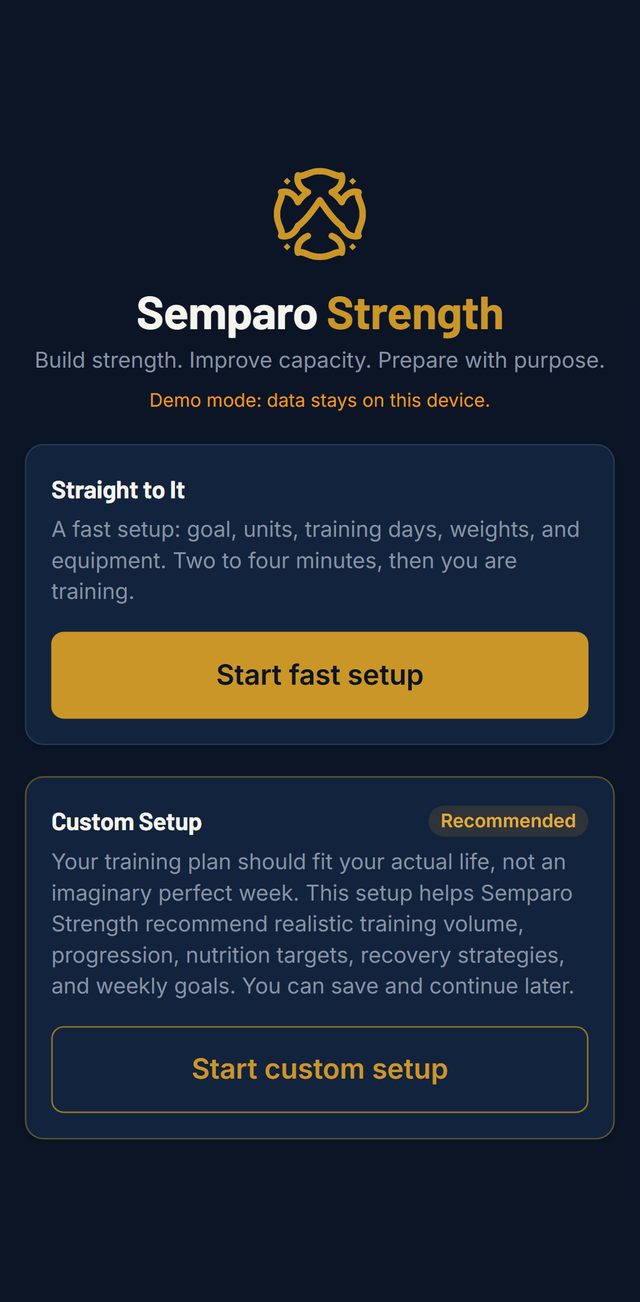
Reading the plan is one thing; running it is another. Semparo Strength is our training app, and every fitness program we build lives inside it. The full A/B five-by-five strength program, custom interval and rest timers, and readiness, sleep, and nutrition logging are free for everyone. Every 12-week test program we publish, Fire Test Foundation, Fire Test Foundation + Swim, CPAT, OFAI FPAT, WFX-FIT, University of Alberta Evaluation, York Firefighter Fitness Assessment, Red Deer Polytechnic FPAT, CFFM FPFE, Gledhill Protocol (Halifax), F.A.R.E., and VO2 Max Builder, unlocks with the Fitness unlock or Semparo Pro, with workout-by-workout tracking and the readiness ring. It runs in the browser and installs to a phone home screen in two taps.