12-week training program
University of Alberta Evaluation 12-Week Program
Know the test
What this evaluation is and who runs it
The Firefighter Applicant Physical Aptitude Evaluation is administered by the Faculty of Kinesiology, Sport, and Recreation at the University of Alberta, in the Work Physiology Laboratory on the Edmonton campus. Candidates book a testing appointment, complete the battery in one visit, receive their own results before they leave, and have those results forwarded to the fire department that sent them. It is a laboratory evaluation rather than a single obstacle course, which makes it unusual among Canadian firefighter tests: one half is a measured aerobic test on a treadmill with expired gases analysed, and the other half is a series of individually timed job simulations. Every component must be passed. Departments choose their own tests and change them between intakes, so confirm with your posting or recruiter that this is the evaluation you have been booked into.
The protective equipment is part of the test
Everything is performed in firefighting personal protective equipment weighing roughly 23 kg (51 lb): helmet, flash-hood, leather work gloves, coveralls, pants, boots, jacket, and a self-contained breathing apparatus that is carried but not breathed from. Running shoes replace the boots for the treadmill portion only. That load changes the arithmetic of every event, and it is why this program treats weighted vest and loaded pack work as a first-class training method rather than a novelty. Training in a vest for part of your sessions is how the equipment stops being a surprise.
How the day is structured
The treadmill test comes first, followed by a 60-minute rest. A standardized walk-through orientation of about 30 minutes then lets you practise each job-related test before it counts, which doubles as your warm-up. The six job simulations follow, and each one is separated by exactly three minutes of rest, taken with the protective equipment left on. You cannot leave the area or shed gear between efforts. Knowing that shape in advance matters: this is not one continuous circuit to be paced, it is six separate maximal efforts on a short, fixed recovery.
The aerobic test: a steep walk, not a run
The treadmill protocol begins with a five-minute warm-up, then holds 3.5 mph at a 10 percent grade for eight minutes. After that the grade rises one percent per minute up to 15 percent, and once there the speed rises half a mile per hour each minute until you cannot continue. A five-minute flat cool-down closes it. To pass you must complete the warm-up, the full eight-minute constant phase, and the cool-down, which is at least 18 minutes of work, and you are scored on both your total time and your peak oxygen uptake. The training implication is direct: the single highest-value session in this program is walking a steep incline under load, not running. This program builds that capacity from week one and never stops developing it.
Equipment carry and vehicle extrication
Within 225 seconds you carry a 20 kg (44 lb) and a 36 kg (80 lb) extrication tool 15 m (50 ft) and set them down, retrieve the lighter tool and carry it a further 7.6 m (25 ft), then hold that tool level and at arm's reach against three separate contact points for 30 seconds each, standing fully erect between holds, before returning both tools to the start. About 105 m (345 ft) of walking under load in total. The three static holds are the most commonly under-trained demand in the whole evaluation: 30 seconds of holding 20 kg away from your body is a grip, shoulder, and trunk problem that no amount of general fitness solves, so this program trains it deliberately from the base phase onward.
Charged hose advance
You pick up a nozzle attached to three lengths of charged 44 mm hose, settle it over your preferred shoulder with both hands, and advance 30 m (100 ft) in 27 seconds or less. Running is not permitted, which makes this a test of how fast you can walk under load with a high cadence and a short stride, and one of the few events where technique alone buys real seconds. The program rehearses the walking speed specifically, because candidates who train it as a run arrive with the wrong gear pattern.
Weighted sled pull
Straddling the rope with your feet planted, you haul a weighted sled 15.24 m (50 ft) hand over hand, walk that distance back, and repeat until three hauls are done, inside 110 seconds. Because the feet stay put, this is not a leg-drive event: it is grip, lats, and a braced trunk pulling rope past your ribs. Rope work and heavy horizontal pulling carry over directly, and this program uses both.
Forcible entry, victim rescue, and ladder climb
Three shorter events close the battery. Forcible entry is a 4.5 kg (10 lb) sledgehammer driven into a mechanically braked target until the buzzer, in 19 seconds or less, which is pure repeatable striking power. Victim rescue is an 83 kg (183 lb) mannequin dragged by its harness through a serpentine course, out to a cone at 15 m and back, 30 m in total, within 57 seconds and without touching a cone. The ladder climb is 10 rungs up and back down a 7.2 m (24 ft) ladder, five times, in 97 seconds or less, with three points of contact maintained and no rung skipped. Together they demand striking power, drag strength, and leg endurance under load, on top of arriving already fatigued.
What to bring and what to expect
Candidates arrive with a medical clearance form signed by a physician, plain leather work gloves with no grip enhancements, government photo identification, and their own towel and lock. Plan clothing for a long day: you will sweat through a shirt on the treadmill and then sit through a 60-minute rest, so a dry change and warm-up layers matter. Test day is several hours of intermittent, very hard work under heat stress from the gear, so rehearse your eating and drinking during training rather than experimenting on the day.
How this program is built
Four phases across twelve weeks. Base builds the aerobic engine and general strength while introducing grip and isometric work. Build layers on the specific demands: hauling, dragging, ladder and stair repeats, and the three-minute-rest repeat-effort format that mirrors the real battery. Peak rehearses the evaluation in order, at or near real loads, in a vest wherever it is safe. Taper drops volume sharply and protects sharpness so you arrive fresh. Benchmarks at weeks 4, 8, and 12 give you numbers to compare rather than a feeling. Every session has substitutions for a full gym, minimal equipment, or nothing but a stairwell and a weighted vest.
The 12 weeks
Benchmarks
Test yourself every four weeks so peak week holds no surprises.
- Week 4: Incline engine and static hold baseline. Two numbers, taken on the same day. First, walk a treadmill at 3.5 mph and a 10 percent grade wearing a 10 to 12 kg (22 to 26 lb) vest or pack, and record how many minutes you can hold it, stopping at 15 minutes even if you could continue. Then, after 10 minutes rest, hold a 20 kg (44 lb) object level and at arm's reach for as long as you can, up to 30 seconds, three times with a full stand-up between each, and record every hold. These two numbers are your baseline: the treadmill number should climb by week 8, and all three holds should reach a full 30 seconds by the peak phase.
- Week 8: Half-battery rehearsal. In a vest or loaded pack of 12 to 16 kg (26 to 35 lb), run four job efforts in order with exactly three minutes of standing rest between each: the carry-and-hold sequence, a 30 m (100 ft) fast walk under a shouldered load, three heavy hauls of 15 m (50 ft), and a heavy drag out to 15 m and back. Record each time and how the rests felt. Whichever effort slipped most against your week 4 work becomes the priority in the Peak phase.
- Week 12: Taper rehearsal. A confidence rehearsal rather than a test. One capped pass through all six job efforts in the real order, each followed by exactly three minutes of standing rest with your kit on, at about 85 percent of your best efforts. The goal is to prove the sequence, the rests, and the gear feel familiar, and to arrive at test day knowing exactly what the day is shaped like. If you finish this feeling like you had more in reserve, the taper is working.
Companion training app
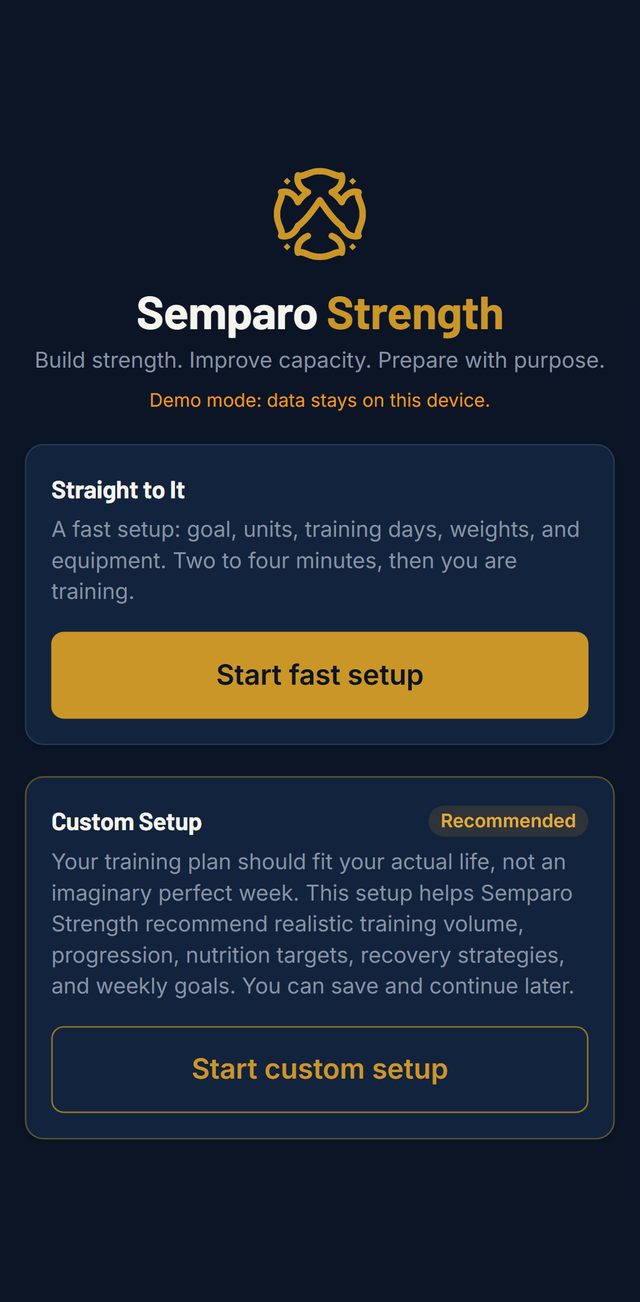
Train and track it in Semparo Strength
Reading the plan is one thing; running it is another. Semparo Strength is our training app, and every fitness program we build lives inside it. The full A/B five-by-five strength program, custom interval and rest timers, and readiness, sleep, and nutrition logging are free for everyone. Every 12-week test program we publish, Fire Test Foundation, Fire Test Foundation + Swim, CPAT, OFAI FPAT, WFX-FIT, University of Alberta Evaluation, York Firefighter Fitness Assessment, Red Deer Polytechnic FPAT, CFFM FPFE, Gledhill Protocol (Halifax), F.A.R.E., and VO2 Max Builder, unlocks with the Fitness unlock or Semparo Pro, with workout-by-workout tracking and the readiness ring. It runs in the browser and installs to a phone home screen in two taps.