12-week training program
Fire Test Foundation 12-Week Program
Know the test
Why a general program exists
Most Canadian departments do not use a nationally branded test. On our department file, roughly one in five run their own evaluation, many more have never published which test they use, and the named tests (CPAT, OFAI FPAT, the University of Alberta evaluation, WFX-FIT, the York-family tests) split the rest between them. Training for a specific test you have not been booked into is a guess. Training the capacities every one of them measures is not, because underneath the branding they are all built from the same job: carry heavy things, climb under load, drag what cannot walk, force what will not open, and do it all again after three minutes of standing rest in kit.
What every Canadian fire test asks, regardless of name
Lay the published Canadian evaluations side by side and the same demands repeat. Stair or incline work under load appears in all of them: the CPAT opens with a stair climb wearing 75 pounds, the University of Alberta evaluation is built around a steep treadmill walk in about 23 kg of gear, and WFX-FIT crosses a ramp roughly 58 times. Hose work appears as drags and advances. Victim rescue appears as a dummy or mannequin drag between 165 and 183 pounds. Carries appear as tools, pumps, and equipment. Forcible entry appears as sledgehammer or machine strikes. Ladders appear as raises, extensions, and climbs. And every test wraps those events in protective equipment and short fixed rests, which is a demand of its own.
The engine: loaded movement, not running
No Canadian fire test asks you to run. They ask you to move continuously under 20 to 25 kg for ten to twenty minutes, mostly uphill or upstairs, which is a different engine than road running builds. This program's aerobic spine is therefore loaded incline and stair work from week one, progressing in load, duration, and grade, with a weighted vest or pack treated as standard equipment rather than an accessory. If your test turns out to be the CPAT stair climb, the U of A treadmill, or a tower climb a department built itself, this is the same engine.
Grip is the quiet gatekeeper
Candidates rarely fail a fire test because their legs gave out. They fail because their hands did: hose lines slip, tool carries get set down, rope hauls stall, and the U of A evaluation makes grip explicit with three 30-second static holds of a 20 kg tool at arm's reach. Grip recovers slowly and adapts slowly, so this program trains it deliberately and early: carries, hangs, holds, and thick, honest volume that builds week over week rather than appearing in the last month.
Repeat-effort capacity: the format is the test
Most tests are not one continuous circuit. They are a series of separate maximal efforts with short fixed rests: exactly three minutes between events at the University of Alberta, brief walks between CPAT events, station transitions everywhere else. Producing one hard effort is fitness; producing your sixth hard effort on an incomplete recovery is preparation. The Build and Peak phases train that format specifically, chaining job efforts on two to three minutes of standing rest so the sensation of starting tired is familiar before it counts.
The strength floor
Underneath the events sits a strength floor: a candidate who can squat, hinge, press, row, and brace under a barbell has a reserve that makes every event submaximal. This program keeps two strength days per week built on those patterns, with loads prescribed by effort rather than percentages so a newer trainee and a returning lifter can run the same plan. If you already run the 5x5 strength program, this program's strength days replace it for these 12 weeks rather than stacking on top: doubling barbell volume is how preparation turns into tendinitis.
How the swim option works
Some departments, mostly coastal and lake cities, add a swim test: typically a continuous swim, treading water, and sometimes an object retrieval, done unaided. Swimming is its own skill and cannot be crammed, so this program offers a swim variant that adds one structured pool session each week, progressing from technique and comfort through continuous distance to a test-style rehearsal. Choose the swim variant if any department on your list tests in water; skip it and the dry-land program is unchanged. If you cannot yet swim 100 metres continuously, book lessons first: a program can condition a swimmer, but it should not teach you to swim.
How this program relates to the test-specific ones
Think of this as the trunk and the test-specific programs as branches. Run Foundation when the test is unknown, unpublished, or department-specific, or as your first 12 weeks when a named test is still months away. When a posting confirms your test and a specific program exists for it (CPAT, OFAI FPAT, WFX-FIT, the University of Alberta evaluation, or the York assessment), switch to it: the app pauses this program with your progress kept, and the specific program's early weeks will feel familiar because they are built from the same movements. Candidates with 16 or more weeks of runway get the best of both: Foundation first, specific program second.
Equipment, honestly
Every session is written for a full gym and carries substitutions for two leaner setups: minimal equipment, meaning a loadable backpack or duffel, a towel, and household objects, and a stairwell-and-vest setup, meaning nothing but stairs and a weighted vest or pack. The job-specific implements are improvised the same way the test-specific programs do it: a duffel stands in for a mannequin, a tire or loaded sled for a drag, a sledgehammer on a tire for forcible entry where you have one, and loaded step-ups where you do not have a tower. None of it requires a fire hall.
The 12 weeks
Benchmarks
Test yourself every four weeks so peak week holds no surprises.
- Week 4: Engine and grip baseline. Two numbers on one day. First: with a 10 to 12 kg (22 to 26 lb) vest or pack, climb stairs or walk a treadmill at a 10 percent grade continuously for as long as you can hold a steady pace, capped at 15 minutes; record minutes completed. Rest 10 minutes. Second: hold a 20 kg (44 lb) object at arm's reach in front of you for up to 30 seconds, three attempts with a full stand-up between them; record every hold. These are the two capacities every Canadian test leans on, and both should move by week 8.
- Week 8: Repeat-effort circuit rehearsal. In a 12 to 16 kg (26 to 35 lb) vest or pack, perform five job efforts in order with exactly three minutes of standing rest between each: a 40 m farmer carry at a heavy but unbroken load, a 30 m fast walk with a shouldered load, three 15 m hand-over-hand rope or sled hauls, a 30 m heavy drag out and back, and 20 hard sledgehammer strikes or 20 explosive step-ups. Record each effort's time and how the third minute of each rest felt. Whichever effort degraded most is your Peak-phase priority.
- Week 12: Taper rehearsal. A confidence pass, not a test: the same five-effort circuit as week 8 at about 85 percent intensity, same three-minute rests, in your vest. The goal is proof that the format, the gear, and the recovery rhythm are familiar. If your department has since named its test, take this week to read that test's event list against what you have built: every demand on it should already have a training history in your log.
Companion training app
Train and track it in Semparo Strength
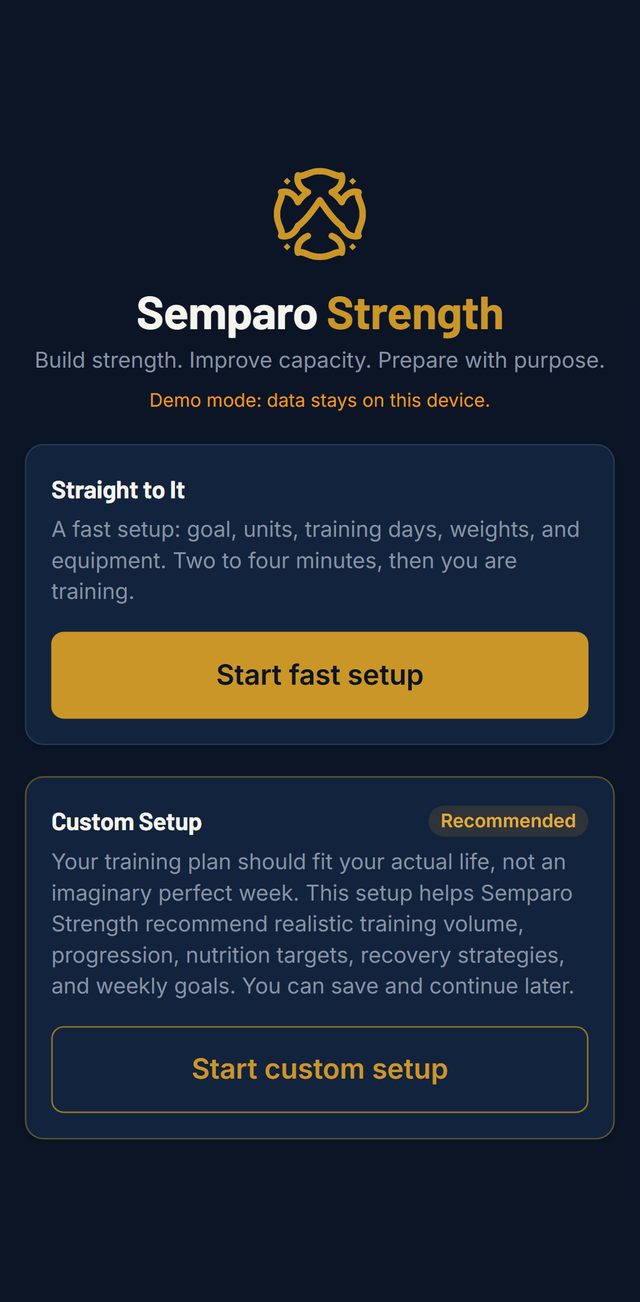
Reading the plan is one thing; running it is another. Semparo Strength is our training app, and every fitness program we build lives inside it. The full A/B five-by-five strength program, custom interval and rest timers, and readiness, sleep, and nutrition logging are free for everyone. Every 12-week test program we publish, Fire Test Foundation, Fire Test Foundation + Swim, CPAT, OFAI FPAT, WFX-FIT, University of Alberta Evaluation, York Firefighter Fitness Assessment, Red Deer Polytechnic FPAT, CFFM FPFE, Gledhill Protocol (Halifax), F.A.R.E., and VO2 Max Builder, unlocks with the Fitness unlock or Semparo Pro, with workout-by-workout tracking and the readiness ring. It runs in the browser and installs to a phone home screen in two taps.